Order a freddo espresso in Athens and you have ordered a drink invented in this city in 1991, descended from one invented by accident in Thessaloniki in 1957, in the wrong shaker, by a man who could not find hot water. That is the whole of Greek iced coffee history, and it is barely seventy years old. For a country that has been drinking coffee since the Ottomans, the drink that now defines it is younger than most of the people ordering it.
Understanding this is not trivia. Coffee is the organising structure of Athenian social life, and if you are staying here for any length of time it will shape your days more than any museum will.
1957: an accident at a trade fair
September 1957, the Thessaloniki International Trade Fair. Dimitrios Vakondios, a representative for Nescafé, wanted an instant coffee during his break and could not find hot water anywhere on the stand. What he could find was a shaker, sitting there to demonstrate a powdered chocolate drink for children. He put in instant coffee and cold water and shook it hard.
What came out was not what he expected. Instant coffee agitated with cold water throws a dense, pale microfoam that sits on top and refuses to collapse. Not blended ice, not cream, not syrup: just foam, made of coffee and air. The frappé had been invented, by a man who wanted something else entirely.
The frappé was invented in 1957, in the wrong shaker
It became the national drink of the Greek summer and held that position for three decades. It also acquired a refiner. Christos Lenzos, who ran a coffee house in Pagrati from 1964 until 2013, is widely credited with perfecting the version most Greeks grew up with. The drink was invented in Thessaloniki and taught its manners in an Athens neighbourhood, which is about as Greek a sentence as can be written.
1991: Athens answers back
Espresso machines arrived in Greece in force at the start of the nineties, and the cafés immediately hit a seasonal problem. Hot espresso sales collapsed every summer, because nobody wanted a scalding cup in July, and frappé swallowed the entire warm-weather market. Roughly thirty years of instant coffee dominance had left espresso stranded for half the year.
In 1991, in Athens, Yiannis Iosifides of the roaster Kafea Terra was pushed by a customer to solve it. After a run of experiments his team arrived at the freddo espresso: a double shot, shaken hard with ice until it goes thick, then strained over fresh ice.
The shaking is the entire invention. Espresso poured over ice dilutes, thins and turns bitter, which is why iced coffee is disappointing in most of the world. Espresso shaken with ice emulsifies: the crema is beaten into the body of the drink and holds as a proper head of foam. Same beans, same machine, completely different result, and it comes down to a wrist.
Greece did not adopt iced coffee. It rebuilt it twice, and both times the answer was to shake it.
Then came the variation that took over the country. Top a freddo espresso with afrogala, cold milk frothed without heat, and you have a freddo cappuccino: bitter underneath, sweet and cold on top, drunk through the foam rather than stirred into it. Through the 2000s it overtook the frappé outright and it has been the default order of an entire nation ever since.
The frappé did not die. It relocated. You will find it on beaches, on building sites, in the hands of people over sixty and anyone who grew up on it, and it remains genuinely good. But order one on a smart pavement in Kolonaki and you are making a statement, whether or not you intended to.
What else is on the menu
Two older things are still served everywhere and are worth knowing.
Greek coffee, ellinikos, is the ibrik-brewed original: finely ground, boiled in a briki, served in a demitasse with the grounds settling at the bottom. It is drunk slowly, never stirred once it has settled, and never drained to the last mouthful unless you enjoy chewing. Older kafeneia in the ring neighbourhoods still make it properly and it costs almost nothing.
Then there is the espresso itself, hot, which Athens now does extremely well. The city has a serious specialty coffee scene, with roasters and cafés that would hold their own in any European capital. It is concentrated exactly where you would expect: the neighbourhoods one ring out, not the tourist streets.
How to order
Sweetness is specified at the point of ordering, not adjusted at the table, and the same three words work across every kind of coffee in the country.
- Sketos: no sugar at all.
- Metrios: medium, and the safe default.
- Glykos: sweet, and sweeter than you are imagining.
- Freddo espresso: shaken double, no milk, the purist’s order.
- Freddo cappuccino: the same, under a lid of cold milk foam.
- Ellinikos: the traditional brew, and do not drink the last centimetre.
A freddo cappuccino metrios is the single most ordered thing in Athens and an entirely respectable place to start. Nobody will judge you for it, which cannot be said of asking for it to go while there are free tables.
You are buying the chair
Here is the thing that takes visitors weeks to understand and that changes everything once it lands. In Athens you are not buying a coffee. You are buying the table, and the hours attached to it.
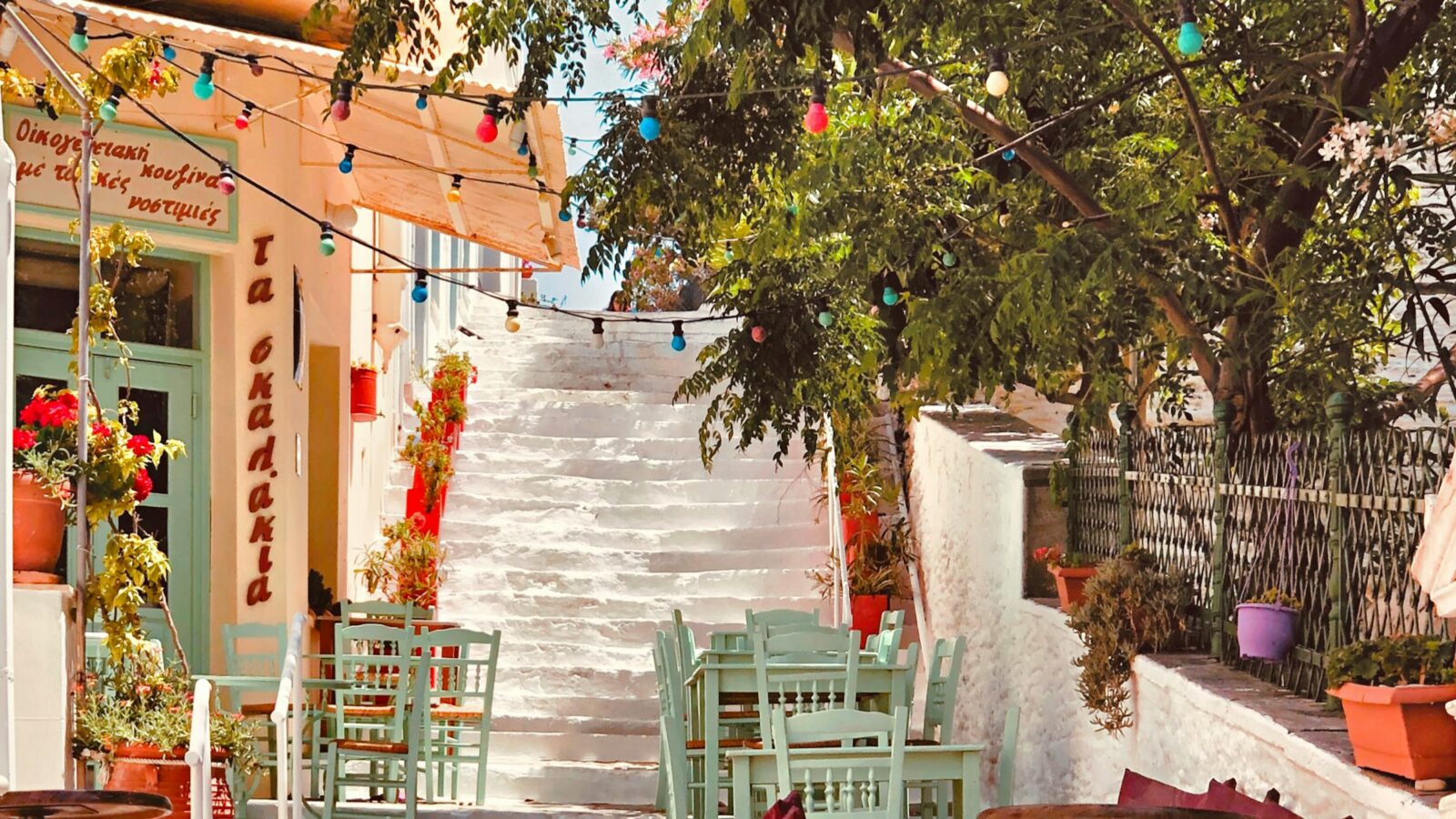
One freddo can hold a chair for three hours. No waiter will come to hurry you, produce a bill you did not ask for, or ask whether you want anything else in that particular tone. Doing so would be openly rude, and it is simply not done. The price of the drink includes the seat, the shade and as much of the afternoon as you care to spend in it.
Which is why coffee here is rarely a solitary transaction. It is how people meet, how business gets started, how arguments get settled and how afternoons get spent. Nobody drinks it standing at a counter. Almost nobody takes it away unless they are genuinely going somewhere. Meeting a Greek friend for coffee is not a twenty-minute appointment; block out the afternoon and be pleased if you get away by six.
It also explains something practical about choosing where to stay. Athenian social life happens outdoors, at pavement tables, within walking distance of home, on ordinary weekday afternoons. A neighbourhood with good cafés has a life in it. One without has residents who go elsewhere for theirs, and if you live there you will end up commuting to your own evenings. That is the argument, at some length, in where Athenians actually live, and the neighbourhood that does it best is probably Pagrati.
So take the table. Order a second one if the conversation is going well. The chair is yours as long as you want it, and that, more than anything on the menu, is the thing worth coming here for.
Find your local in Athens
Furnished apartments in neighbourhoods with pavement tables worth sitting at.